
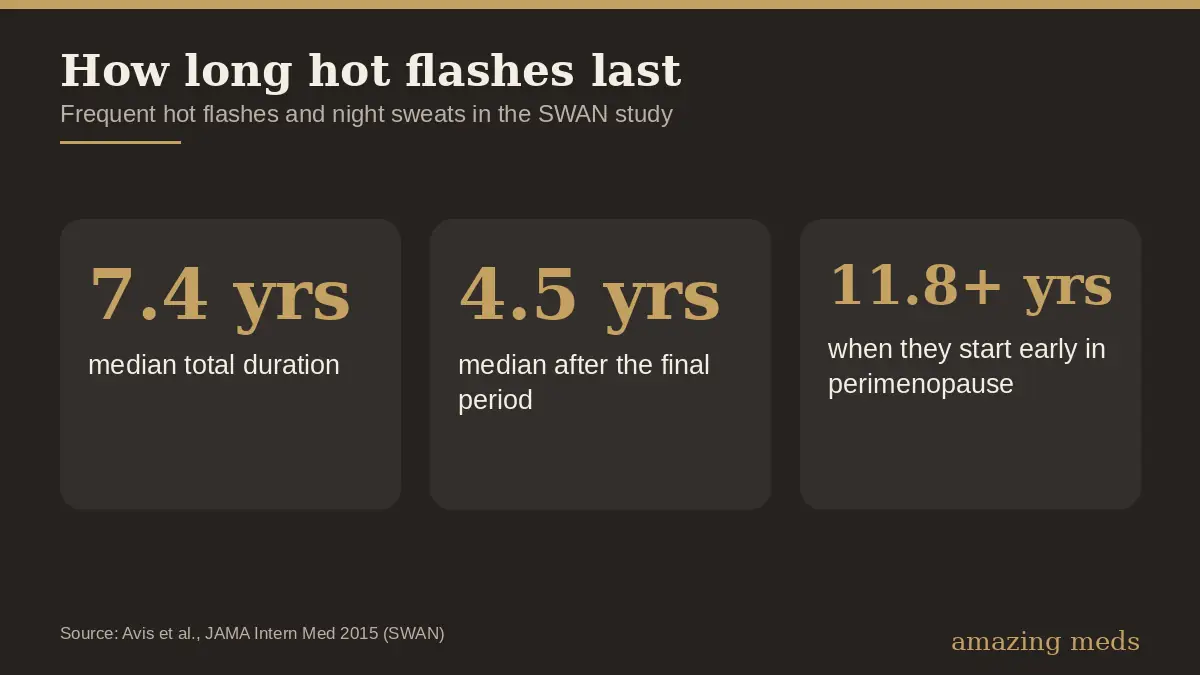
Menopause is a milestone, confirmed after 12 consecutive months without a period when there is no other cause. The menopausal transition usually lasts about seven years and can last up to 14. In a large US study, frequent hot flashes or night sweats lasted a median of 7.4 years. Among women whose final menstrual period was observed, symptoms persisted for a median of 4.5 years afterward.
Vaginal and urinary symptoms often get worse after the hot flashes fade, so how long it lasts depends on the symptom.
If you are a few years in and still waiting for things to settle, book your free consultation and get a plan in place now.
Menopause, perimenopause and postmenopause
Menopause is defined looking backward. After 12 consecutive months without a period, when pregnancy, medication and other causes have been excluded, the final menstrual period can be identified retrospectively. Natural menopause occurs around age 51 on average in the US, according to the National Library of Medicine.
Perimenopause includes the menopausal transition, when hormone levels fluctuate and cycles change, and extends through the first year after the final period. For some women it starts in their 40s or earlier.
Everything after the menopause date is postmenopause. Some symptoms fade during it, and a few show up for the first time.
How long does perimenopause last?
That seven-year average hides a lot of variation, and it is easier to see stage by stage. Researchers use a framework called STRAW+10 (Stages of Reproductive Aging Workshop), which stages women by what their cycles are doing, so two 47-year-olds can sit in very different places on it.
| Stage | What marks it | Typical length |
|---|---|---|
| Early menopausal transition | Persistent cycle-length variation of at least 7 days, recurring within 10 cycles | Varies widely |
| Late menopausal transition | Gaps of 60 days or more between periods | About 1 to 3 years |
| Menopause | The final menstrual period, identified after 12 months without periods and no other cause | A milestone, confirmed retrospectively |
| Early postmenopause | The first years after the final period | About 5 to 8 years |
| Late postmenopause | Everything after that | The rest of life |
Why the late transition feels the most chaotic
Hot flashes often begin in the late transition and are most likely in the first couple of years after the final period. Hormones swing hard in this window, so follicle-stimulating hormone (FSH, the pituitary signal that pushes the ovaries) can look menopausal one month and normal the next.
One blood test rarely tells you where you are for exactly that reason. The Endocrine Society notes that hormone levels fluctuate, so test results may not be consistent during perimenopause. A clinician considers cycle history, symptoms and age, and may use tests to rule out other causes or guide treatment.
How long do menopause symptoms last?
The best data come from the Study of Women’s Health Across the Nation (SWAN), which enrolled 3,302 women at seven US sites and followed them from 1996 to 2013. Researchers looked closely at 1,449 of them who had frequent hot flashes or night sweats.
For more than half of those women, frequent symptoms lasted longer than seven years. Writing in JAMA Internal Medicine in 2015, the authors told clinicians to counsel women that hot flashes could last that long, and even longer for African American women.
Early starters have the longest run
Women whose hot flashes began while they still had regular periods, or early in perimenopause, had them for a median of more than 11.8 years in total, about 9.4 of those after the final period. Women whose hot flashes started only after menopause had the shortest course, a median of 3.4 years.
These group estimates cannot predict how long an individual person’s symptoms will last.
Differences by race and ethnicity
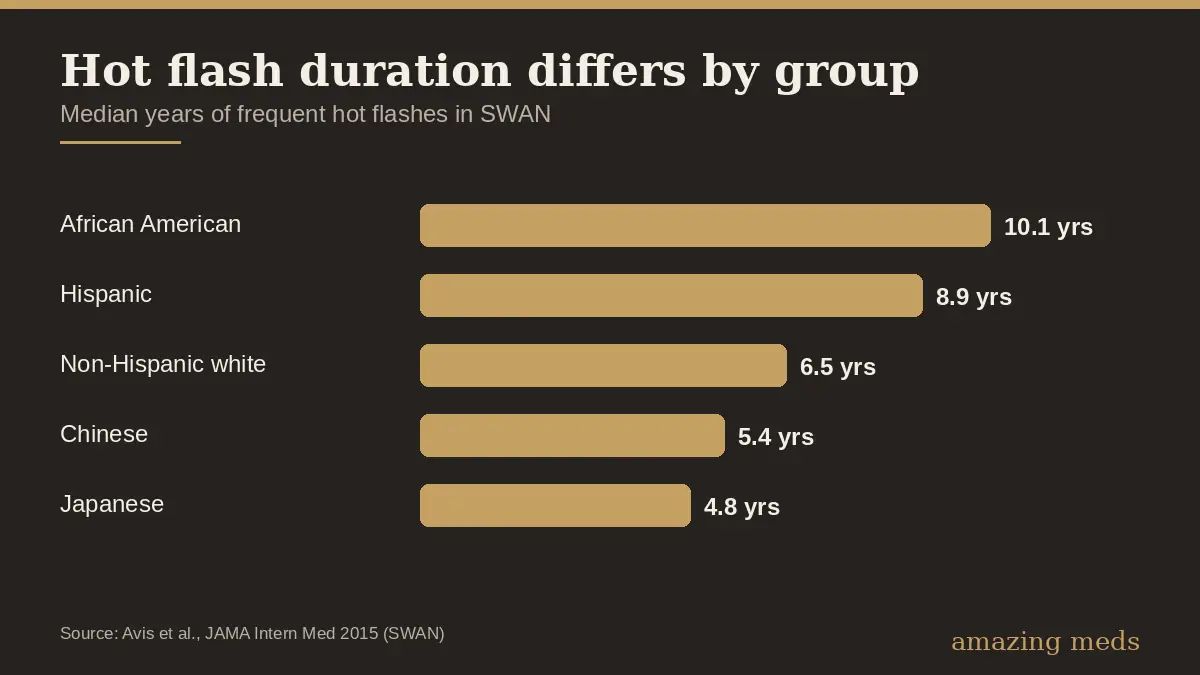
SWAN also found clear differences between groups, from a median of 10.1 years for African American women down to 4.8 years for Japanese women.
| Group in SWAN | Median years of frequent hot flashes |
|---|---|
| African American | 10.1 |
| Hispanic | 8.9 |
| Non-Hispanic white | 6.5 |
| Chinese | 5.4 |
| Japanese | 4.8 |
Longer symptoms also went along with younger age at onset, lower education level, higher perceived stress, and more depressive or anxiety symptoms when hot flashes first appeared. These are group medians, not individual predictions.
For what is going on in the body during a hot flash, our post on what causes hot flashes in menopause explains the brain’s temperature control center and why falling estrogen throws it off.
The symptoms that do not fade on their own
A woman whose hot flashes faded at 58 can find her vaginal symptoms getting worse at 62. Hot flashes usually ease in time, sometimes after a decade, while vaginal and urinary symptoms often get worse.
This group of symptoms has a name, genitourinary syndrome of menopause (GSM). It covers vaginal dryness and burning, pain with sex, urinary urgency, and repeat urinary tract infections. A 2020 position statement estimates GSM affects roughly 27% to 84% of postmenopausal women and describes it as generally progressive without treatment, and it is underdiagnosed. Women often assume dryness and bladder changes are just part of getting older, so they put up with them for years.
A symptom timeline at a glance
| Symptom | Usual pattern |
|---|---|
| Irregular periods | Early and late transition; ends at menopause |
| Hot flashes and night sweats | Often longer than seven years, frequently continuing well past the final period |
| Vaginal dryness, painful sex, urinary symptoms | Often start later and tend to worsen without treatment |
| Bone loss | A long-term concern after menopause; hormone therapy prevents bone loss and fracture |
How a free consultation works at Amazing Meds
If your symptoms have already gone on for a while, start with a free consultation with our care team. It comes before any medical visit. On that call the team sees if we can help, answers your questions, verifies your insurance and, if you want to go ahead, books your labs and your first provider visit. Outside labs from the last 180 days count if they include the markers we need.
We work with most major insurance plans for provider visits and lab work, including Aetna, Cigna, TRICARE, BCBS and UnitedHealthcare. Coverage depends on your specific plan, network and benefits; copays, deductibles and other out-of-pocket costs may apply. If you have Medicare or Medicaid, we cannot bill it. Paying on your own, the first provider visit is $185 and follow-ups are $140. Medication is self-pay, and your care manager walks you through its cost after that first visit, so you know the cost before you start. There is also a one-time $75 enrollment fee if you move forward, and there is no membership. Confirm your specific costs and payment options with the care team before starting.
Book a free consultation for care through our menopause program.
Treating symptoms that last for years
If this could last most of a decade, it is worth deciding early whether you want treatment. Our guide to menopause hot flashes treatment compares the options in more depth.
Hormone therapy
The Menopause Society’s 2022 hormone therapy position statement calls hormone therapy the most effective treatment for hot flashes and for GSM and notes that it prevents bone loss and fracture. For women under 60, or within 10 years of their final period, who have no contraindications, the benefit-risk balance is favorable.
The FDA has since updated hormone therapy labeling. It announced in November 2025 that it would remove the boxed warnings about heart disease, breast cancer and probable dementia from menopause hormone therapy labels, and approved the first batch of updated labels in February 2026. One boxed warning stays on systemic estrogen-alone products, the one about endometrial cancer, because estrogen without a progestogen can overgrow the uterine lining. Women with a uterus using systemic estrogen generally need endometrial protection with a progestogen. Low-dose vaginal estrogen is different. These labeling changes do not mean hormone therapy is risk-free; cardiovascular and breast-cancer risks remain described elsewhere in labeling.
Your provider determines whether hormone therapy is appropriate after reviewing your history, symptoms, risks and any testing needed. Benefits and risks vary with formulation, dose, route and timing.
How long can you stay on it?
There is no single cutoff. Longer use should rest on a documented reason, such as hot flashes that persist, with shared decisions and regular check-ins, so you and your provider revisit the plan over time instead of stopping on a set date. We go further into this in can you take HRT for the rest of your life.
Options without hormones
For women who cannot or prefer not to take hormones, the 2023 nonhormone position statement from the same group supports cognitive behavioral therapy, clinical hypnosis, certain antidepressants (SSRIs and SNRIs), gabapentin and fezolinetant for hot flashes. Fezolinetant can rarely cause serious liver injury and requires liver testing before and during treatment. On October 24, 2025, the FDA approved elinzanetant, a second drug that acts on the brain’s temperature control signals.
For GSM, low-dose vaginal estrogen, vaginal DHEA and oral ospemifene are all options once over-the-counter lubricants and moisturizers stop being enough.
When not to wait
A few symptoms need a prompt or same-day answer:
- Any bleeding after menopause. Once you have gone 12 months without a period, any bleeding or spotting needs a prompt exam.
- Chest pain, sudden weakness, trouble speaking, or a drooping face. These are emergency signs. Get emergency care immediately.
Many menopause symptoms overlap with thyroid problems and sleep disorders, and labs help sort those out.
Frequently asked questions
How long does menopause last?
Menopause is a milestone confirmed after 12 months without a period and no other cause. Symptoms can last for years before and after the final period.
How long does perimenopause last?
It varies a lot. Once your periods start coming two months or more apart, you are usually in the last stretch, and menopause tends to follow within a few years.
How long do menopause symptoms last?
When symptoms started is one factor associated with duration. Hot flashes that begin before your periods change tend to last the longest, while those that start after your last period are usually shorter.
Can a blood test tell me how far along I am?
Hormone levels swing from month to month in perimenopause, so one result is not reliable, and your cycle pattern over the past year usually tells a provider more.
Do vaginal dryness and urinary symptoms go away after menopause?
They usually persist or worsen without treatment. Low-dose vaginal estrogen is a common option, and at those doses a progestogen is generally not needed. Your clinician should review your personal history and any bleeding.
Is bleeding after menopause normal?
No. Book an exam promptly, even for light spotting.
If your hot flashes started before your periods changed
A provider can sort out what is driving your symptoms and what will help. Book a free consultation, or read more about our menopause care first. This article is general education, not a diagnosis.
Sources
- National Library of Medicine, MedlinePlus Magazine. Menopause overview.
- Harlow SD, et al. Executive summary of the Stages of Reproductive Aging Workshop + 10 (STRAW+10). 2012. PMC3340904.
- Endocrine Society. Understanding your menopause diagnosis.
- Avis NE, et al. Duration of menopausal vasomotor symptoms over the menopause transition. JAMA Internal Medicine. 2015;175(4):531-539. PubMed 25686030.
- The 2020 genitourinary syndrome of menopause position statement of The North American Menopause Society. Menopause. 2020. PubMed 32852449.
- The 2022 hormone therapy position statement of The North American Menopause Society. Menopause. 2022. PubMed 35797481.
- JAMA. November 2025 Viewpoint on the FDA’s removal of boxed warnings from menopausal hormone therapy labels. JAMA.
- US Food and Drug Administration. FDA approves labeling changes for menopausal hormone therapy products. February 2026.
- The 2023 nonhormone therapy position statement of The North American Menopause Society. Position statement.
- US Food and Drug Administration. FDA approves elinzanetant (Lynkuet) for vasomotor menopausal symptoms. October 2025.
- US Food and Drug Administration. Fezolinetant and rare serious liver injury.