

By Dr. Jennifer Frangos, D.O. | Updated November 2026
A peptide prescription is written in milligrams or micrograms. An insulin syringe is marked in units. This peptide calculator converts one to the other, for powder vials you mix with bacteriostatic water and for vials that arrive already mixed.
It handles the reconstitution and dosing math in one place and never suggests a dose.
Peptide dosage calculator
U-100 syringes only. The drawing assumes 2-unit marks on a 100-unit syringe and 1-unit marks on smaller syringes. Check the actual markings on your syringe with your pharmacist; brands differ. Do not round a prescribed dose to a nearby line.
Start here
Enter the peptide in your vial, the water you add, and your prescribed dose.
- ConcentrationAdd vial and water
- One unit holdsAdd vial and water
- Full doses per vialAdd your dose
Zero is at the needle end. Read the dose at the edge of the plunger closest to the needle.
Amazing Meds patient? Your prescription label already lists your dose. Follow the label. If this calculator shows something different, stop and message us at support@amazing-meds.com before you inject.
Concentration first, then units
Start with concentration: the peptide in the vial divided by the water you add. Divide your prescribed dose by that concentration to get mL, then multiply by 100 for units on a U-100 insulin syringe.
Adding more water doesn’t add peptide. It spreads the same amount across more units, which can make a small dose easier to see. If you don’t have a prescription yet, our free consultation lets you ask the care team questions first.
How the peptide dosage math works
- Divide the mg in the vial by the mL of water added to get the concentration. A liquid vial already has this number on the label.
- Divide your prescribed dose by the concentration to get a volume. Keep both in the same unit, mg or mcg.
- Multiply that volume in mL by 100. A U-100 insulin syringe holds 100 units in every 1 mL.
Here is the first step with real vial numbers. A 10 mg vial mixed with 2 mL of bacteriostatic water is 5 mg per mL. Each unit on a U-100 syringe then holds 50 mcg, so your draw in units is your prescribed dose in mcg divided by 50.
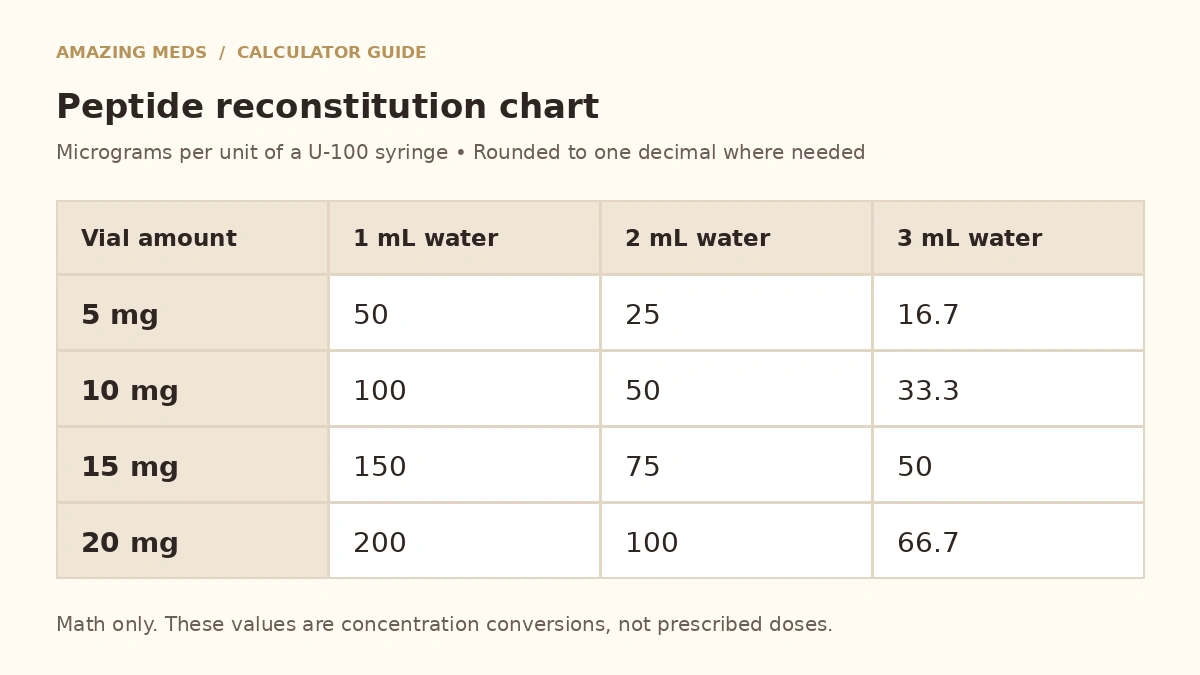
Peptide reconstitution chart
This chart shows how much peptide ends up in each unit of a U-100 insulin syringe for common vial sizes and water amounts. Find your vial and your water, then divide your prescribed dose in mcg by the number in the box.
| Peptide in the vial | 1 mL of water | 2 mL of water | 3 mL of water |
|---|---|---|---|
| 5 mg | 50 mcg per unit | 25 mcg per unit | 16.7 mcg per unit |
| 10 mg | 100 mcg per unit | 50 mcg per unit | 33.3 mcg per unit |
| 15 mg | 150 mcg per unit | 75 mcg per unit | 50 mcg per unit |
| 20 mg | 200 mcg per unit | 100 mcg per unit | 66.7 mcg per unit |
The chart shows the math, not how much water you should use. Follow the mixing directions from your pharmacy or prescriber.
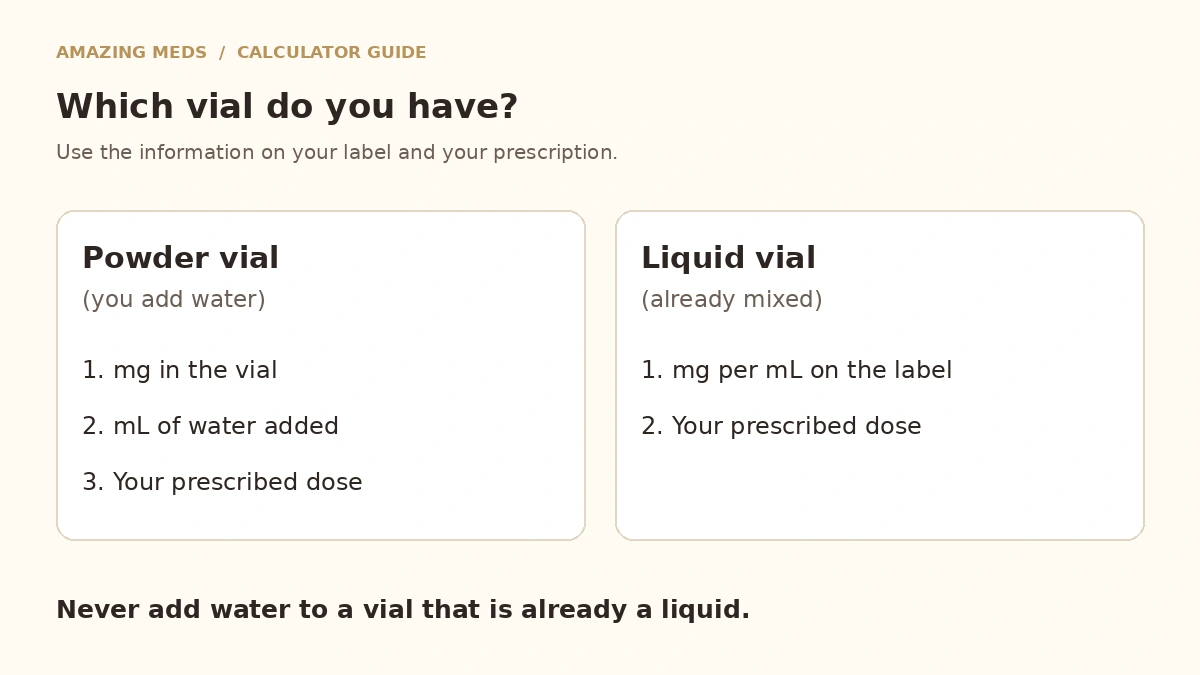
Powder vial or liquid vial?
Powder vials have to be mixed before use, so the math needs two numbers: the mg in the vial and the mL of water added. Liquid vials are already mixed, so you only need the concentration printed on the label in mg/mL.
Some compounded medications ship as a liquid. If yours does, choose Liquid in the calculator, and never add water to a vial that is already a liquid.
One calculator for any peptide
The math is the same whatever is in the vial, whether it holds one peptide or a blend. Only three numbers matter: what is in the vial, how much liquid it is in, and the dose you were prescribed.
Many peptides sold online are not approved drugs. Our guide on whether you need a prescription for peptides explains the difference.
Why syringe units cause dosing mistakes
A milligram is 1,000 micrograms, and both measure the peptide itself. Milliliters measure liquid. Units are the marks on an insulin syringe, and on a U-100 syringe 100 of them make 1 mL.
Units cause real mistakes because they measure liquid, not peptide, so 10 units from two different vials can hold very different amounts. The Scientist described a man who did not understand what the units on his syringe meant and took far too much (The Scientist).
Before you draw
- Use a dose from a licensed prescriber. A calculator cannot tell you what dose is right for you.
- Follow your pharmacy’s directions for mixing, storage and the discard date on the label.
- Use a new sterile syringe every time and never share needles.
- If the number here does not match your label or your prescriber’s directions, stop and ask before injecting.
How Amazing Meds approaches peptides
Amazing Meds is a telehealth clinic that prescribes hormone therapy and peptides. Of the six peptides in the 2026 HHS draft policy, we prescribe BPC-157, MOTS-c, Semax and Epitalon. Peptide care here is usually handled online without a live visit: you complete an intake, and a licensed provider reviews it and prescribes only if a treatment fits your health history. Our peptide hub lists which peptides we prescribe and where each stands in 2026, and the how it works page covers the rest.
Frequently asked questions
How do I calculate a peptide dose in units?
Divide the peptide in the vial by the water you added to get the concentration. Divide your prescribed dose by that concentration to get the volume in mL. Multiply the mL by 100 to get units on a U-100 insulin syringe.
Does the amount of bacteriostatic water change my dose?
No. Water changes the concentration, not the amount of peptide in the vial, so it changes how many units your dose takes up. With a 10 mg vial, each syringe unit holds 100 mcg with 1 mL of water, 50 mcg with 2 mL and about 33 mcg with 3 mL. Use the amount your pharmacy or prescriber gave you.
What is a unit on an insulin syringe?
On a U-100 syringe, 100 units equal 1 mL, so one unit is 0.01 mL. A unit is a measure of volume. It does not tell you how much peptide you are getting until you know the concentration in the vial.
Is a peptide calculator the same as a reconstitution or bac water calculator?
A peptide dose calculator, a peptide reconstitution calculator and a bac water calculator all do the same math: they work out the concentration after bacteriostatic water is added, then turn a prescribed dose into a volume and a number of syringe units. This page also handles vials that arrive already mixed.
My vial is a blend. What do I enter?
Blend labels list the amount of each ingredient. Enter the amount for the ingredient your dose is written in. If your dose is written as the total blend, enter the total of all ingredients. Ask your prescriber which way your dose is written if you are not sure.
How many doses are in my vial?
Divide the total peptide in the vial by your dose. The calculator rounds down to full doses. A small amount is always left in the vial and the needle, so the real count can be slightly lower.
Does the calculator tell me what dose to take?
No. It only converts a dose you already have into units. Your dose comes from your prescriber.
Our testosterone dosage calculator for women does the same job for testosterone vials and compares strengths.
Educational only, not medical advice. This tool does arithmetic and won’t recommend, confirm or change a dose. Many peptides are not FDA-approved drugs, and their legal status is changing. Always follow your prescriber’s directions and the label from your pharmacy.