
By Dr. Jennifer Frangos, D.O. | Updated November 2026
Peptide therapy online is legitimate only when a licensed provider reviews your history and a licensed pharmacy makes what you’re prescribed. Vials shipped with “for research use only” on the label don’t meet either test. This page shows which peptides have real evidence behind them, where each one stands legally in 2026, and which ones Amazing Meds prescribes. Each name links to its own guide.
If you’re new to peptides, our peptide prescription explainer covers the basics.
Already have instructions from your prescriber? Our peptide calculator helps convert a prescribed dose and vial concentration into syringe units. It does not choose a dose or replace your care team’s instructions.
FDA-approved, compounded or research-only
FDA-approved peptide drugs
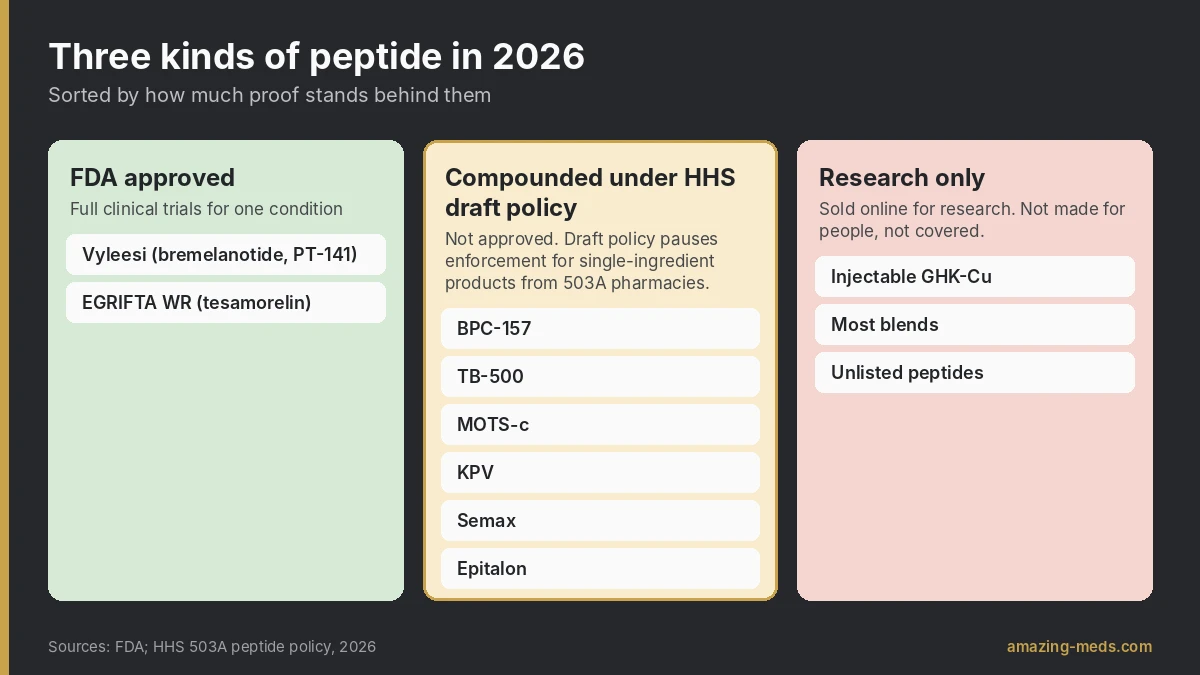
These went through full clinical trials for a specific condition. Bremelanotide, the peptide often called PT-141, is approved as Vyleesi for acquired, generalized hypoactive sexual desire disorder in premenopausal women (FDA, 2019). Tesamorelin is approved as EGRIFTA WR to reduce excess abdominal fat in adults with HIV and lipodystrophy (EGRIFTA label). Approval covers that condition and that product, not every way the peptide gets marketed.
Compounded peptides under the 2026 HHS draft policy
A draft HHS policy dated October 28, 2026 names six peptides: BPC-157, TB-500, MOTS-c, KPV, Semax and Epitalon. For each, HHS says it doesn’t plan to pursue enforcement against licensed 503A pharmacies that compound it as the only ingredient, by the routes listed, under a set of conditions. HHS calls this enforcement discretion. It isn’t approval, none of the six has been added to the 503A bulks list, HHS can pull the policy, and the evidence for most of them is still mainly animal work. The full list of conditions and allowed routes is in the HHS peptide policy.
Research-only peptides
Everything else sold online in vials labeled for research. These products aren’t made for people, nothing checks what’s in them, and the 2026 policy doesn’t cover them. That includes injectable GHK-Cu and most multi-peptide blends.
Find a peptide by goal
| If you’re looking into… | Peptide | Best human evidence so far | 2026 status |
|---|---|---|---|
| Injury and gut healing | BPC-157 | 3 small uncontrolled studies with 30 people combined | HHS draft policy, single ingredient |
| Tendon and muscle recovery | TB-500 | No human trials of TB-500; small trials used the full protein, thymosin beta-4 | HHS draft policy, single ingredient |
| Metabolism and exercise capacity | MOTS-c | None with MOTS-c itself; one 4-week trial of a modified version | HHS draft policy, single ingredient |
| Inflammation and skin | KPV | Mouse and cell studies only | HHS draft policy (skin and mouth only) |
| Focus and memory | Semax | One small uncontrolled 1996 study and one abstract | HHS draft policy (nasal spray only) |
| Sleep and aging | Epitalon | One placebo-controlled trial that didn’t measure sleep | HHS draft policy, single ingredient |
| Libido | PT-141 (bremelanotide) | Two 24-week placebo-controlled trials in premenopausal women | FDA approved as Vyleesi |
| Skin and hair | GHK-Cu | Topical studies; injectable form untested | Topical: cosmetic, or compounded cream (FDA Category 1). Injectable: no pathway. |
| Belly fat and growth hormone | Tesamorelin | Clinical trials in HIV-related lipodystrophy | FDA approved as EGRIFTA WR for that use |
| Healing (BPC-157 alternative) | Pentadeca arginate (PDA) | No published human trials | Not in the HHS draft policy |
About peptide blends
Stacks like KLOW and the Wolverine stack combine two or more peptides in one vial. The HHS draft policy covers single-ingredient products only, so a blend falls outside it even when every peptide inside is on the list. Blends also haven’t been tested as combinations in people.
Peptide therapy online at Amazing Meds
Ask your provider about current availability and whether an option fits your history. Amazing Meds sees patients by telehealth in all 50 states, mostly for hormone care, so the provider who reviews your peptide intake can also look at sleep, weight and hormone symptoms in the same visit. If a peptide you ask about isn’t one we offer, your provider will say so on the call. Here’s how a visit works.
Quick answers
Can I get peptide therapy online?
A licensed provider reviews your history before recommending treatment. Ask your provider about current availability and whether an option fits your history. Sites that sell vials with no prescription are selling research products.
Which peptides are FDA approved?
Several peptide drugs are, including Vyleesi (bremelanotide) and EGRIFTA WR (tesamorelin), each for a specific condition. None of the six peptides in the 2026 HHS draft policy is FDA approved.
Do I need labs to start a peptide?
Most peptides can be prescribed for a healthy patient after a provider review. If additional testing is needed, your provider will decide whether more labs are needed based on your history and treatment plan.
Do blends count under the draft policy?
No. It applies only to products with one active peptide, so any blend falls outside it.
This page is educational and isn’t medical advice. Peptide rules are changing in 2026, and availability depends on your provider’s assessment and state pharmacy rules.