

By Dr. Jennifer Frangos, D.O. | Updated November 2026
MOTS-c is a 16-amino-acid peptide coded by the DNA inside your mitochondria, and your muscles release more of it when you exercise (Reynolds et al., 2021). Nearly every benefit you’ll see listed for it, from better insulin sensitivity to running farther, was measured in mice. When the FDA reviewed it in 2026, the agency found no clinical studies and no human exposure data for MOTS-c itself (FDA briefing on MOTS-c).
For an overview of peptide evidence and regulatory status, explore our peptide therapy hub.
A peptide your body already makes
A team at the University of Southern California described MOTS-c in 2015 after combing mitochondrial DNA for small, overlooked genes. In their mouse work it acted mostly on skeletal muscle and switched on AMPK, a sensor cells use to track their energy supply. Treated mice resisted the insulin resistance that normally comes with age and with a high-fat diet (Lee et al., 2015).
Six years later the same group put 10 healthy, inactive young men on stationary bikes. MOTS-c in their thigh muscle rose almost 12-fold after the ride, and blood levels rose by about half before drifting back to baseline after four hours of rest (Reynolds et al., 2021). The study measured what the body makes during exercise. No one in it was given MOTS-c.
Which claims were tested, and in whom
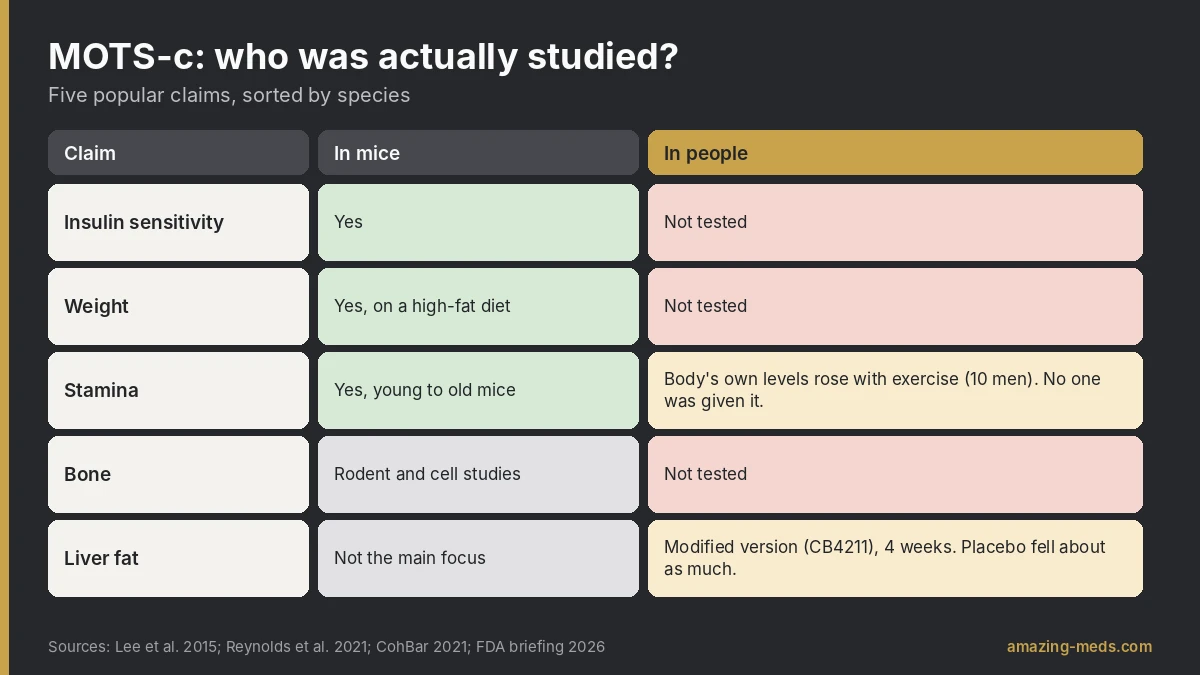
Here is each popular claim, matched to who was actually studied.
| Claim | In mice | In people |
|---|---|---|
| Improves insulin sensitivity | Prevented insulin resistance from aging and from a high-fat diet | Not tested with MOTS-c |
| Helps with weight | Less weight gain on a high-fat diet | Not tested with MOTS-c |
| Boosts stamina and physical function | Young, middle-aged and old mice all performed better; very old mice treated late in life walked and gripped better | Exercise raised the body’s own MOTS-c in 10 young men. Nobody was given MOTS-c. |
| Protects bone | Rodent and cell studies only | Not tested |
| Lowers liver fat | Not the focus of the main studies | Tested only with a modified version called CB4211, for four weeks. Liver fat fell about as much on placebo. |
Sources: Lee et al., 2015; Reynolds et al., 2021; CohBar trial results.
The only human dosing trial used a cousin molecule
CohBar, a biotech company co-founded by one of the scientists behind the MOTS-c discovery, built a modified version called CB4211 and tested it in adults with obesity and fatty liver disease. In the four-week, placebo-controlled part of the trial, 11 people got daily CB4211 injections and 9 got placebo. The liver enzyme ALT dropped 21% on CB4211 and rose 4% on placebo, and blood sugar came down too. Liver fat fell by nearly the same amount in both groups, about 5 percentage points. Injection-site reactions were the most common side effect (CohBar). The company later stopped developing the drug (Public Citizen).
So the only controlled human data come from a different molecule, given for four weeks to 11 people. Liver enzymes improved more than on placebo, while liver fat did not.
No human blood-level data
Lab work cited by FDA reviewers found that MOTS-c breaks down quickly in human blood in a test tube, and no study has tracked an injected dose in a person (FDA briefing on MOTS-c). Without that data, the mouse results can’t be translated into what an injection does in a human body.
The 2026 votes and the HHS draft
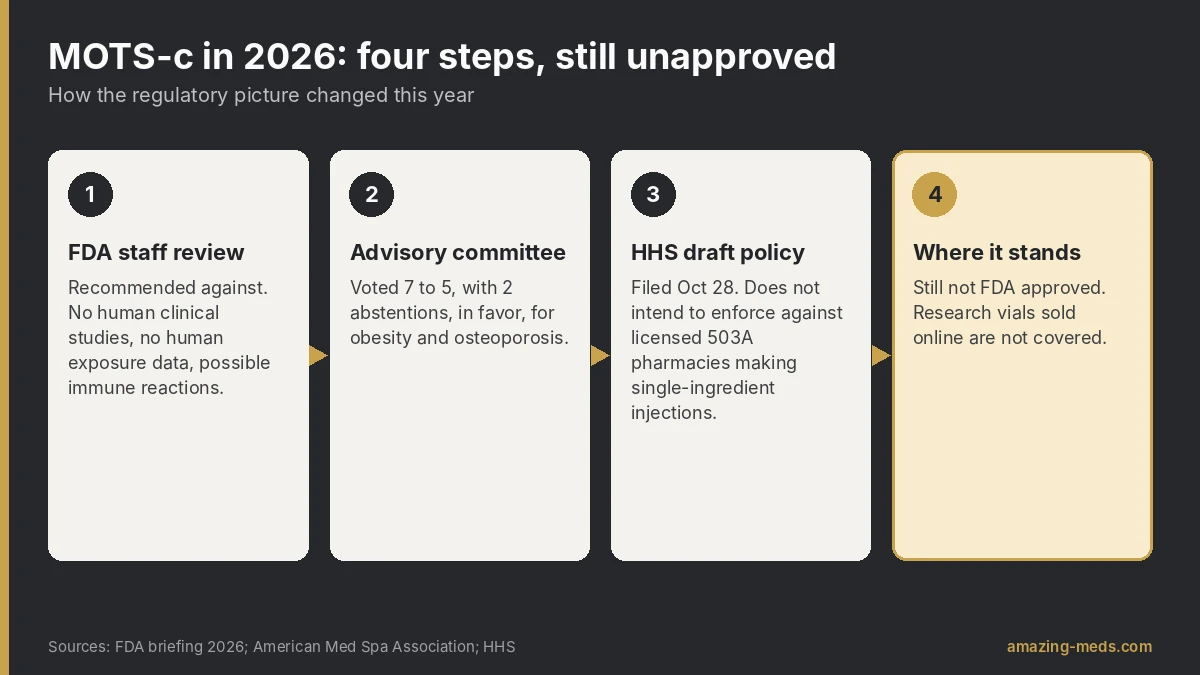
The FDA’s own reviewers recommended against adding MOTS-c to the list of ingredients compounding pharmacies may use. They pointed to the missing human studies, the lack of nonclinical safety work supporting human use, and the chance of immune reactions from impurities or clumped peptide (FDA briefing on MOTS-c). The agency’s outside advisory committee disagreed. At its July 2026 meeting it voted 7 to 5, with two abstentions, to recommend MOTS-c for obesity and osteoporosis (American Med Spa Association).
Then, in a draft policy filed October 28, 2026, HHS said it doesn’t intend to take enforcement action against licensed 503A pharmacies that compound MOTS-c as a single ingredient, injected under the skin or into muscle, if they meet a list of conditions. Public comments are open through November 13, 2026. MOTS-c still isn’t FDA approved or on the official compounding list, and HHS can withdraw the policy at any time. Research vials sold online fall outside it. The details are in the HHS peptide policy.
Before you consider it
- If you take insulin or another medicine that lowers blood sugar, say so up front. MOTS-c research centers on glucose, and there’s no human data on how the two interact.
- Competitive athletes should skip it. The 2026 anti-doping list names MOTS-c among metabolic modulators banned at all times (WADA).
- There’s no safety information for pregnancy or breastfeeding.
- A vial labeled “research use only” isn’t made for people and isn’t covered by the HHS policy.
Getting MOTS-c through Amazing Meds
MOTS-c is one of the peptides from the HHS list that our providers prescribe, as a single-ingredient product. You fill out an online intake, and a provider reviews your history and medications before deciding whether it fits. Most peptides can be prescribed for a healthy patient after a provider review. If additional testing is needed, your provider will decide whether more labs are needed based on your history and treatment plan. If weight or blood sugar is your main goal, expect your provider to bring up FDA-approved medicines too, since those were tested in thousands of people and MOTS-c wasn’t.
The first call with the Amazing Meds care team is free, and you can ask about MOTS-c before you start the intake. Here’s how the process works.
MOTS-c questions
Is MOTS-c a hormone?
Some researchers call it a mitochondrial hormone because it travels in the blood and acts on tissues away from where it was made (Reynolds et al., 2021). It isn’t regulated or tested like a hormone medicine.
Does MOTS-c help with weight loss?
Mice on a high-fat diet gained less weight on it. It hasn’t been tested for weight loss in people, and the FDA noted that approved weight-loss drugs already exist.
How is MOTS-c different from CB4211?
CB4211 is a modified MOTS-c that CohBar built as a drug candidate. It’s the only MOTS-c-related molecule tested against placebo in people, and its results can’t be assumed to carry over to MOTS-c.
Can exercise raise MOTS-c?
In a small 2021 study, a bike ride raised MOTS-c in the muscle and blood of young men. Exercise has well-proven benefits of its own either way.
Can pharmacies compound MOTS-c in 2026?
Federal law doesn’t allow it yet, because MOTS-c isn’t on the 503A bulks list. What the October 28 draft from HHS does is signal that the agency doesn’t plan to act against licensed 503A pharmacies making MOTS-c, with nothing else mixed in, for injection, provided they meet the listed conditions. FDA approval is still missing, and research vials are excluded.
What side effects does MOTS-c have?
There’s no published human safety data for MOTS-c itself. Injection-site reactions were the most common side effect of CB4211, and the FDA flagged possible immune reactions from impurities.
This is education, not medical advice. MOTS-c has not been tested in people as a treatment, and its compounding status may change. Ask your provider how MOTS-c fits with your own history and medications.