

By Dr. Jennifer Frangos, D.O. | Updated November 2026
Semax is a registered drug in Russia, sold there as nasal drops in two strengths. It has never been approved in the United States, and when FDA reviewers searched for human evidence in 2026 they concluded there was “insufficient evidence of effectiveness” for every use it evaluated (FDA briefing on Semax). Part of that gap is about which studies count: the FDA set aside papers published only in Russian.
For an overview of peptide evidence and regulatory status, explore our peptide therapy hub.
How the 2026 votes and HHS policy treat Semax
At its July 2026 meeting, the FDA’s advisory committee voted 8 to 5, with one abstention, to recommend adding Semax to the ingredients compounding pharmacies may use (American Med Spa Association). It did so even though the FDA’s own review, which the committee had in front of it, found insufficient evidence that Semax works.
In late October, HHS filed a draft policy covering Semax and five other peptides. For Semax, it says HHS doesn’t intend to act against licensed 503A pharmacies that compound it as a nasal spray with no other active ingredient, under a set of conditions. Capsules, injections and blends get nothing from it. Semax is still not FDA approved and still not on the official compounding list, and a draft can change. For the conditions, see the HHS peptide policy.
Seven amino acids borrowed from a hormone
Four of Semax’s seven amino acids come from a fragment of ACTH, a hormone made by the pituitary gland. Russian chemists tacked three more onto the end, a sequence thought to make the peptide more stable (FDA briefing). It was designed to be dropped into the nose.
The record FDA could read
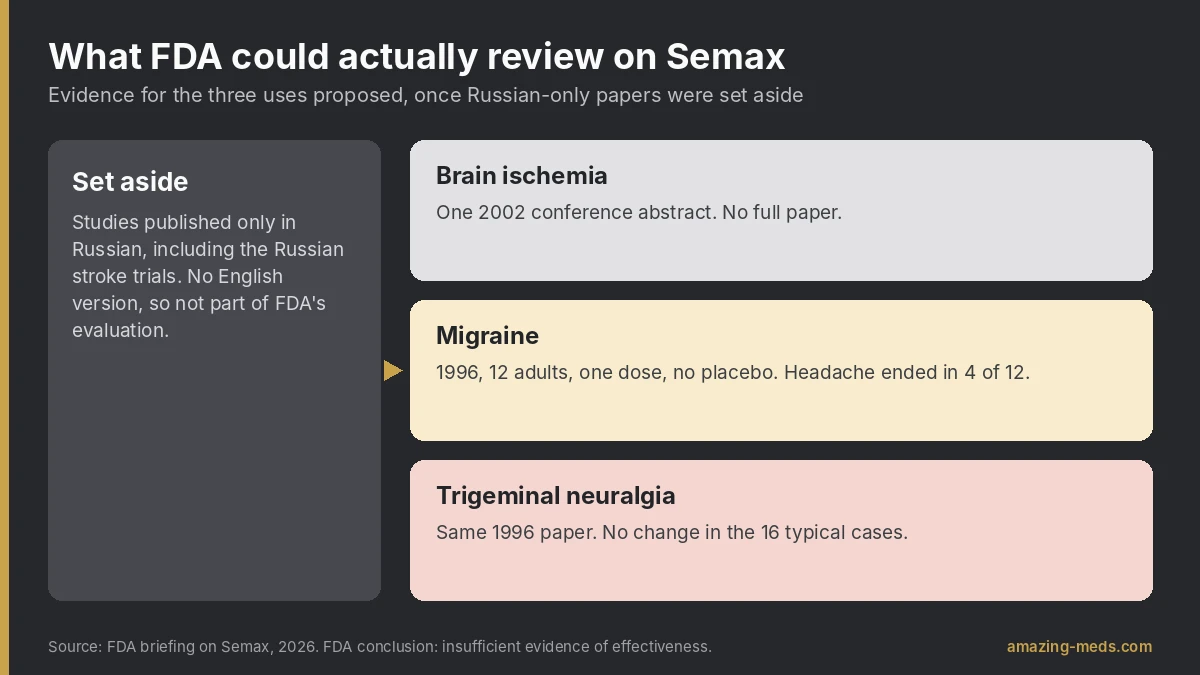
Three uses were put forward: brain injury from reduced blood flow, migraine, and trigeminal neuralgia, a stabbing facial nerve pain. The Russian stroke studies were among the papers left out because they had no English version.
For brain ischemia, reviewers found one conference abstract from 2002. No full paper exists, so the methods and numbers couldn’t be checked.
The headache evidence was a 1996 study of 12 adults, each given a single dose with nobody on placebo. In 4 of them the headache ended within 90 to 120 minutes. With no comparison group, there’s no telling how many would have eased on their own.
That same paper enrolled 25 adults with facial nerve pain, 16 of them with typical trigeminal neuralgia. In those 16, Semax made no difference. The other 9 had a dental nerve pain, and all of them improved. Reviewers noted the authors’ own conclusion that Semax “does not exhibit analgesic activity by itself” (FDA briefing on Semax).
For those three uses, FDA had one abstract and one small open-label study from 1996.
Rats, BDNF and the focus claims
The memory and focus claims you see online lean on animal work. In one rat study, Semax raised BDNF, a protein that helps nerve cells survive and form new connections, by about 1.4 times in the hippocampus, and it switched on BDNF’s receptor (Dolotov et al., 2006). The rise was real in rats. No controlled study has tested whether people think more clearly on Semax.
Four flags in FDA’s safety review
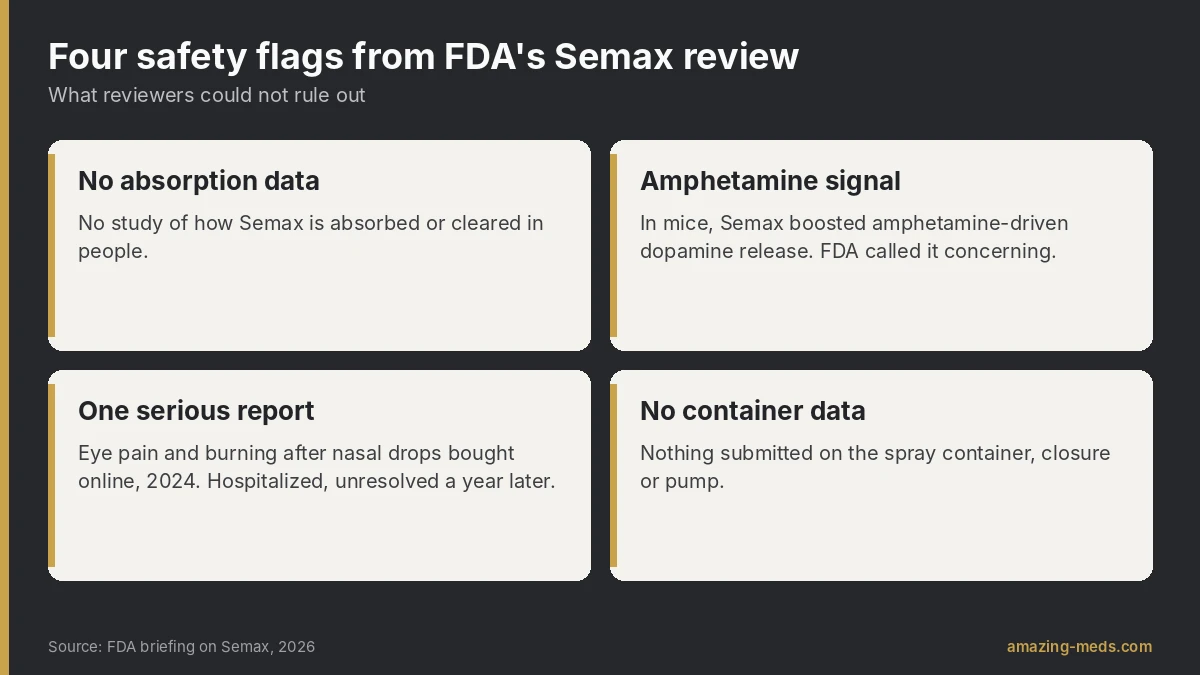
- Reviewers could not find any study of how Semax is absorbed or cleared in people.
- In mice, Semax boosted the dopamine surge from amphetamine, which FDA called “concerning.” That could matter for anyone on stimulant medication.
- FDA’s adverse event database holds one report. In 2024, a person who bought nasal drops online developed eye pain and burning, was hospitalized, and still hadn’t recovered a year later.
- FDA had strong concerns about a compounded nasal spray because nothing was submitted on the container, closure or pump.
Where Selank comes in
Semax is often sold next to Selank, a related Russian peptide marketed for calm rather than focus. Selank isn’t covered by the HHS draft policy, and neither is any product that combines peptides. A Semax and Selank combination sits outside the 2026 rules.
Semax at Amazing Meds, and the brain fog question
Trouble with memory and concentration is common around menopause, and researchers cautiously suggest it usually eases after the transition (Monash Lens). Sleep is one of the factors doctors look at when it shows up.
Ask your provider about current availability and whether an option fits your history. Mention any stimulant medication, given the amphetamine finding above. Because we also treat menopause by telehealth, the same provider can look at your sleep, night sweats and focus, and may discuss hormone care when appropriate for your symptoms. You can see how a first visit works.
Common Semax questions
Does Semax improve memory?
Sellers market it that way, but the memory claims come mostly from rat studies, such as one showing higher BDNF. No controlled study has shown it sharpens thinking in healthy people.
Why isn’t Semax approved in the US?
Nobody has run the trials FDA approval requires. In its 2026 review, the FDA found insufficient evidence of effectiveness for all three uses it evaluated.
What forms of Semax does the HHS draft cover?
Only a nasal spray with Semax as the sole active ingredient, made by a licensed 503A pharmacy that meets the draft’s conditions. Semax still isn’t FDA approved or on the 503A bulks list.
What safety problems has the FDA raised?
Missing human absorption data, a mouse study where Semax amplified amphetamine’s effect on dopamine, one eye injury report that led to a hospital stay, and no information on spray containers.
How is Semax different from Selank?
They’re separate Russian peptides, one sold for focus and the other for calm. Only Semax is named in the 2026 HHS draft policy.
This page is for education and isn’t medical advice. Semax is not FDA approved, and the rules around compounded peptides may change. Talk with a licensed provider before starting any peptide.