

By Dr. Jennifer Frangos, D.O. | Updated November 2026
You may have seen KPV called “the safest peptide.” KPV has almost no record of side effects in people for a simple reason: it has almost no record in people at all.
For an overview of peptide evidence and regulatory status, explore our peptide therapy hub.
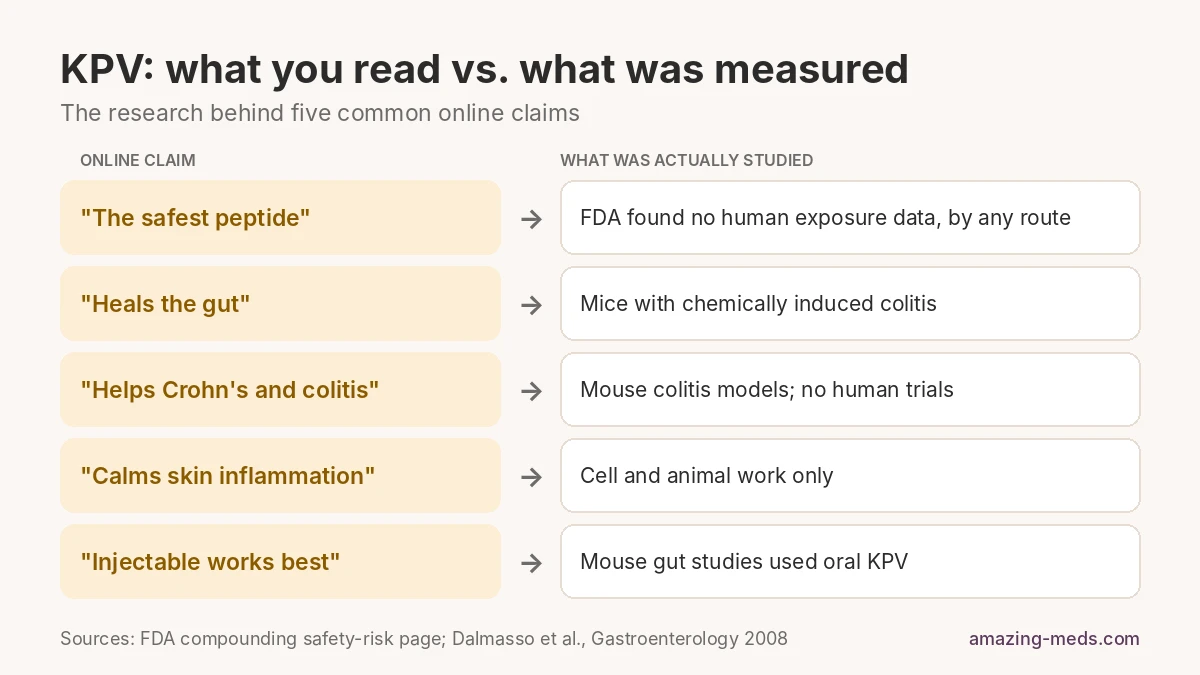
What you’ve read vs. what was measured
| What you’ll see online | What the research actually looked at |
|---|---|
| “The safest peptide” | The FDA found no human exposure data for KPV by any route. So there’s no human safety record to call safe. |
| “Heals the gut” | Mice with chemically induced colitis, given KPV by mouth |
| “Helps Crohn’s and ulcerative colitis” | Mouse models of colitis. No human trials found. |
| “Calms skin inflammation” | Cell and animal work only |
| “Injectable KPV works best” | The mouse gut studies gave it by mouth. The HHS policy doesn’t cover injected KPV. |
Sources: FDA; Dalmasso et al., 2008; HHS, Appendix B.
Gut symptoms come first
If KPV caught your eye because of bloating, diarrhea, belly pain or a diagnosis like ulcerative colitis, the most useful step is a proper workup. Ulcerative colitis and Crohn’s disease are diagnosed with tests such as stool tests and colonoscopy, and they have established treatments (NIDDK). Nothing about KPV is a reason to stop those. Bleeding, fever, weight loss you can’t explain or pain that wakes you up should be seen in person, not managed with a peptide.
What KPV is
KPV is a three-amino-acid peptide (lysine, proline and valine) taken from the tail end of a natural hormone called alpha-MSH, which plays a role in calming inflammation. In lab work, KPV gets into gut lining cells and immune cells through a transporter called PepT1, which becomes more active in an inflamed colon (Dalmasso et al., 2008).
That transporter is the main reason KPV gets talked about for the gut, and it’s why the oral form matters more for KPV than for most peptides.
The mouse studies
The paper cited most often is from 2008. Researchers gave KPV in drinking water to mice with two kinds of chemically induced colitis, and those mice had less inflammation (Dalmasso et al., 2008). Later work tested KPV in a mouse model of colitis-linked cancer: it reduced tumor formation in normal mice but not in mice lacking the PepT1 transporter (Viennois et al., 2016).
Those results come from mice. A colitis model in a mouse is a chemical injury made in a lab, and many treatments that help mice never help people. FDA reviewers looked for human trials of KPV before the July 2026 advisory meeting and found none that backed the uses pharmacies proposed (Drug Topics).
The safety picture has the same gap. The FDA’s page on risky compounding ingredients says the agency “has not identified any human exposure data” for KPV given by any route, so it can’t say whether KPV would cause harm in people (FDA). Reddit threads and seller pages can’t fill that gap, because no one is tracking who used what, from where, at what purity.
The oral question
Many peptides are broken down in the gut, which is why so many are injected. KPV’s appeal by mouth rests on its size. PepT1 normally carries two- and three-amino-acid fragments of digested protein into cells, and KPV is small enough to ride along (Dalmasso et al., 2008). That’s the case for oral KPV reaching gut cells, and in the 2008 mouse work, KPV given by mouth still reduced colitis. Nobody has shown the same thing in people.
The HHS policy treats that as an open question too. It allows KPV by mouth only if the compounder has documentation that the specific oral formula is adequately absorbed in humans (HHS, Appendix B). A capsule labeled “enteric coated” or “gut targeted” isn’t that documentation.
What about KPV on the skin?
Skin is the other route the HHS policy covers, and it’s where some of the eczema and psoriasis talk comes from. The support for it is cell and animal work, and no human trial has tested KPV for any skin condition. If you’re offered a topical KPV product, it helps to know which kind it is: a compounded cream made for you on a prescription falls under the policy’s conditions, while a serum sold online as a cosmetic or “research” product doesn’t.
What the 2026 rules allow
KPV made the HHS list of six on October 28, 2026, with narrow limits (Holland & Knight):
- Route: on the skin or by mouth only. Injected KPV isn’t covered.
- Single ingredient: KPV on its own, not mixed with other peptides.
- Proof it’s absorbed: for oral products, as above.
- A prescription: it has to be made for one patient by a qualifying pharmacy.
Source: HHS, Appendix B.

None of this is approval. HHS can pull it back, and the text was still open for comment in November, with comments due November 13 (Holland & Knight). Some sites still advertise injectable KPV, a route the policy as written leaves out. Our guide on whether you need a prescription for peptides covers the research-vial market, and Is BPC-157 legal? shows how the same rules play out for a better-known peptide.
KPV inside blends
A lot of people meet KPV without looking for it. It’s the ingredient that sets the KLOW blend apart from GLOW, which leaves it out. Those blends are usually sold as injectable vials, so they miss the HHS policy twice: blends aren’t covered, and KPV isn’t covered by injection (HHS, Appendix B). If you’ve been using KPV from a research vial and something feels off, stop and tell a provider what you took, where it came from and when you started.
Where Amazing Meds fits
At Amazing Meds, it starts with a free call where you can say what you were hoping KPV would do, then an online intake that a licensed provider reviews. We won’t promise a prescription. You can read how Amazing Meds works first.
More KPV questions
Is KPV FDA-approved?
No. An FDA advisory committee voted 8 to 6 in July 2026 to recommend adding it to the compounding list, but that vote is advice, not approval (AJMC).
Oral or injectable KPV for gut issues?
The mouse gut studies used oral KPV, and the HHS policy covers oral and skin forms only. No human study compares the two.
Does KPV cause tanning like Melanotan?
KPV comes from the same hormone family, which is why people ask. We found no evidence that KPV by itself darkens skin, but there’s also no human data to rule out effects.
Can I take KPV with my IBD medication?
There are no interaction studies. Talk with your gastroenterologist first, and don’t stop a proven treatment to try it.
Will a “research use only” vial meet pharmacy standards?
No. The policy requires the raw ingredient to come from an FDA-registered manufacturer with a full certificate of analysis, and research vials sold online aren’t made for people (HHS, Appendix B).
Is KPV the same as alpha-MSH?
No. KPV is just the last three amino acids of alpha-MSH. The full hormone has other effects in the body that a three-piece fragment may not share.
Why did FDA advisers vote for KPV if there’s no human data?
The July 2026 committee voted 8 to 6 in favor, against the recommendation of FDA staff (AJMC). The committee had been reshaped weeks earlier, with at least eight new members, some with ties to peptide businesses or clinics (Orrick). A vote to allow compounding is a policy call, not a finding that KPV works.
What’s the difference between KPV acetate and KPV free base?
They’re two forms of the same peptide, and the FDA’s advisers reviewed both (FDA). The HHS policy names KPV acetate specifically, so a product made from a different form doesn’t fit its conditions (HHS, Appendix B).
Do I need a prescription for KPV?
For a compounded KPV product, yes. The HHS policy only covers KPV made by a qualifying pharmacy for one patient on a prescription. Research vials and products sold as supplements fall outside it, whatever their labels say.
This is education, not medical advice. KPV has not been tested in people, and its compounding status is temporary. Talk with a licensed provider about your health history before starting any treatment.