

By Dr. Jennifer Frangos, D.O. | Updated November 2026
Picture a 43-word sentence. Now copy out 7 words from the middle and sell them as if they meant the whole thing. That’s roughly the relationship between TB-500 and thymosin beta-4.
Thymosin beta-4 is a protein your body makes, 43 amino acids long. TB-500, as the FDA identifies it, is a 7-amino-acid fragment of it, and the agency’s briefing says plainly that the two “are not the same substance” (FDA briefing on TB-500). Most of the human research people quote for TB-500 was done on the full protein, which is why the difference matters before you read any claim about healing.
For an overview of peptide evidence and regulatory status, explore our peptide therapy hub.
Side by side
| Thymosin beta-4 | TB-500 | |
|---|---|---|
| What it is | A 43-amino-acid protein found in most of the body’s cells | A synthetic 7-amino-acid fragment of that protein |
| Human trials | Small trials as a skin gel and eye drops | None found by FDA reviewers |
| FDA-approved? | No | No |
| HHS peptide policy (Oct 2026) | Not listed | Listed, as TB-500 acetate, by injection, on its own |
| Sport | Banned | Banned |
Sources: FDA; Goldstein et al., 2012; Drug Topics; HHS, Appendix B; WADA.

One complication: sellers use “TB-500” loosely, sometimes for the fragment and sometimes for the full protein. A label alone won’t tell you which one is in the vial.
The studies people cite, and which molecule each one used
Here’s the human research that shows up most often in TB-500 marketing. Look at the second column.
| Study | Molecule and form | Who | What it found |
|---|---|---|---|
| Guarnera et al., 2010 | Full thymosin beta-4, skin gel | 73 people with venous leg ulcers | Acceptable safety; the authors said it may have the potential to speed healing |
| Sosne and Ousler, 2015 | Full thymosin beta-4, eye drops | 72 people with dry eye | Missed its main goals; some secondary measures improved |
| SEER-1 trial, 2023 | Full thymosin beta-4, eye drops | 18 people with a hard-to-heal corneal condition | 6 of 10 healed vs. 1 of 8 on placebo; just short of statistical significance |
| TB-500 itself | The 7-amino-acid fragment, injected | No published human trials | FDA found no human clinical studies supporting its proposed uses |
TB-500 row: Drug Topics, summarizing FDA’s July 2026 review.
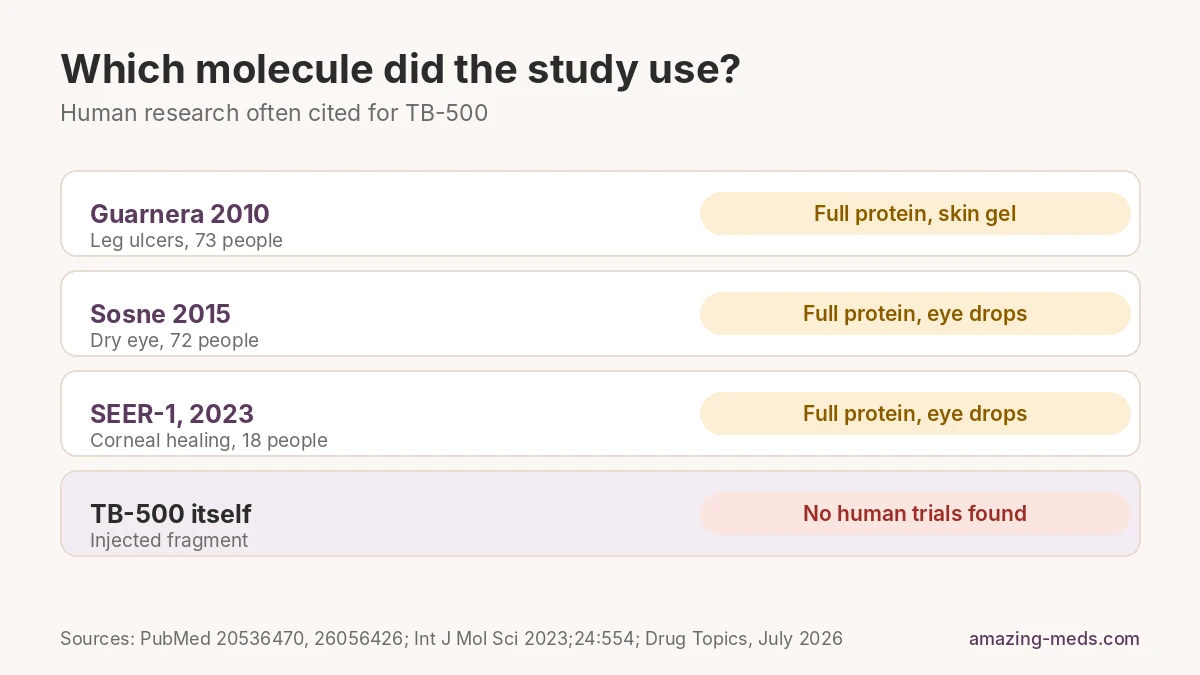
None of the human results involve injecting a fragment into muscle or under the skin. A gel on a leg ulcer and drops in an eye can’t tell us what an injected piece of the protein does to a torn tendon.
Why a fragment can’t borrow the whole protein’s results
A protein’s job depends on its whole shape. The full thymosin beta-4 molecule binds actin, a building block cells use to move, and that’s the activity behind its repair research (Goldstein et al., 2012). The 7-amino-acid piece in TB-500 comes from the stretch the FDA describes as the actin-binding region (FDA briefing on TB-500), which is why people expect it to act the same. Until a fragment is studied on its own, in people, its effects are a guess drawn from a different molecule.
Four questions to ask about any TB-500 claim
- Which molecule? If the study used thymosin beta-4, it isn’t a TB-500 study.
- Which route? Eye drops and skin gels don’t predict what an injection does.
- Animals or people? Animal healing data show something is worth studying in people. They can’t tell you what it does in you.
- Was there a comparison group? Injuries often improve with time and rest. Without a control group, there’s no way to know what the peptide added.
The FDA’s staff and HHS don’t agree
TB-500 has moved around a lot in three years. The FDA placed it in Category 2, its group of compounding ingredients that may raise significant safety concerns, in 2023. Its listed concerns were immune reactions from the peptide clumping or carrying impurities, and no human safety data (FDA). In April 2026, the FDA announced it would take TB-500 off that list because the nomination was withdrawn, which by itself didn’t make it eligible for compounding (Frier Levitt).
In July 2026, the FDA’s advisory committee voted 8 to 6 to recommend adding TB-500 to the compounding list, against the advice of FDA staff (AJMC). In late October, HHS went further. It said it does not intend to take enforcement action against licensed 503A compounders using TB-500 acetate, if it’s injected under the skin or into muscle, on its own, under the policy’s 10 conditions (Holland & Knight).
HHS was open about the split. Its policy acknowledges that the FDA’s drug center recommended against listing each of the six, and it described the center’s TB-500 concerns as inferred from how the peptide works rather than seen in people (AJMC). HHS characterized the concerns as inferential rather than observed; human safety remains unknown.
Cancer is the other open question. The FDA’s briefing found no cancer-risk studies of TB-500 at all (FDA briefing on TB-500). Separately, research has tied thymosin beta-4 to tumor growth and spread in several cancer types (Morita et al., 2018). That’s a signal from cell, animal and tumor-sample studies, not proof that TB-500 causes cancer in people. It’s still a reason anyone with active or recent cancer should talk with their oncologist before considering it.
The policy’s limits for TB-500:
- HHS can revise or withdraw the policy, and it doesn’t make TB-500 an approved drug.
- It covers one specific form, TB-500 acetate. Full-length thymosin beta-4 isn’t on the list.
- A vial mixing TB-500 with BPC-157, the so-called Wolverine stack, is outside it (Drug Topics).
- Research-use vials sold online aren’t covered at all.
If you’re comparing it with its usual partner, our post on BPC-157 vs. TB-500 lays the two side by side, and What is BPC-157? covers the other half of that pairing.
Athletes: thymosin beta-4 and anything derived from it
The 2026 anti-doping list names thymosin beta-4 and its derivatives, with TB-500 as the example, and bans them at all times (WADA). The fragment-versus-protein distinction doesn’t help here. Both are covered.
Talking it through with us
If you’re looking at TB-500, there’s probably an injury that hasn’t healed the way you hoped. Amazing Meds is a telehealth clinic that prescribes peptides and hormone therapy, and a free call is a place to start that conversation, and a licensed provider will look at whether any option fits your history under today’s rules. The answer may not be a peptide. The steps are laid out on our how Amazing Meds works page.
TB-500 questions, answered
Is TB-500 the same as thymosin beta-4?
No. TB-500, as the FDA identifies it, is a 7-amino-acid fragment. Thymosin beta-4 is the full 43-amino-acid protein. Some sellers blur the two, so the name on a vial doesn’t settle it.
Has TB-500 been tested in people for injuries?
Not in any published trial we could find, and FDA reviewers found no human clinical studies supporting its proposed uses in 2026.
Why do some vials say “thymosin beta-4” and others “TB-500”?
There’s no standard naming in the research-chemical market. Only a certificate of analysis from a known manufacturer can show what’s actually in a vial.
What does “TB-500 acetate” mean?
Acetate is the salt form the peptide is made in. It matters because the HHS policy names TB-500 acetate specifically, so another form or a product with an unclear identity doesn’t qualify (HHS, Appendix B).
Is TB-500 still banned in sport in 2027?
Nothing announced for 2027 lifts the ban. The 2027 list takes effect January 1 and adds more examples to the S0 class for unapproved substances (World Triathlon). Nothing in the 2026 compounding changes affects that.
Is thymosin alpha-1 related to TB-500?
Only by name. Thymosin alpha-1 is a different peptide from the same family of thymus proteins, studied for immune function. It isn’t a fragment of thymosin beta-4 and isn’t interchangeable with TB-500.
Can TB-500 be taken by mouth?
The HHS policy covers TB-500 acetate only by injection under the skin or into muscle. No oral or nasal form is included.
Does TB-500 help with hair or skin?
We found no human studies of TB-500 for hair or skin. The skin-related human data belong to full thymosin beta-4 used as a gel on leg ulcers.
Is TB-500 the same as a growth hormone peptide?
No. Growth hormone peptides such as sermorelin work on the pituitary gland. TB-500 is a fragment of a protein involved in cell movement and has nothing to do with growth hormone release.
This is education, not medical advice. TB-500 has no human trials and no FDA approval. Talk with a licensed provider about your health history before starting any treatment.