

By Dr. Jennifer Frangos, D.O. | Updated November 2026
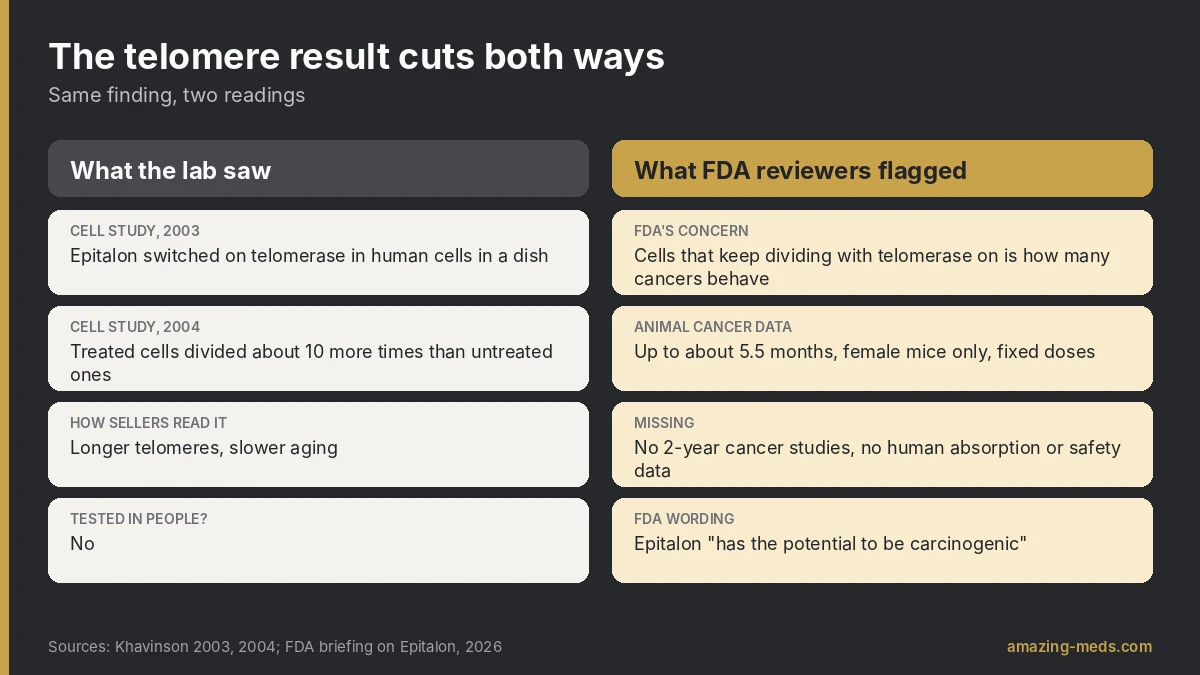
Epitalon is a four-amino-acid peptide sold as an anti-aging and sleep treatment, mostly on the strength of one lab result: in a dish of human cells, it switched on telomerase, the enzyme that rebuilds the protective tips of chromosomes. When the FDA reviewed Epitalon in 2026, it looked at that same mechanism and wrote that “epitalon has the potential to be carcinogenic” (FDA briefing on Epitalon).
For an overview of peptide evidence and regulatory status, explore our peptide therapy hub.
Telomeres in a dish
Telomeres are caps on the ends of your chromosomes that shorten each time a cell divides. Short telomeres are linked with aging. In 2003, researchers in St. Petersburg added Epitalon to human fetal fibroblasts, a type of connective tissue cell, and reported that telomerase turned on and the telomeres grew longer (Khavinson et al., 2003). In the follow-up, untreated cells stopped dividing after 34 passages while treated cells went on for about 10 more (Khavinson et al., 2004).
Cells that switch on telomerase and keep dividing are also how many cancers behave, and FDA reviewers raised exactly that point. The animal cancer studies they found involved intermittent treatment totaling about five and a half months of exposure at most, used only female mice, and tested only fixed doses. Nobody has run the standard two-year cancer studies, and there’s no human data on how Epitalon is absorbed or how safe it is over time (FDA briefing).
Nearly all from one lab
Epitalon grew out of work by Vladimir Khavinson’s group in St. Petersburg. They first studied epithalamin, an extract of cattle pineal glands that contains many substances, and later built Epitalon as a single synthetic molecule (Ala-Glu-Asp-Gly) based on it. The FDA treats the two as separate: it “considers epitalon and epithalamin as different substances” (FDA briefing). Few of the group’s results have been repeated by another lab, so read any telomere or lifespan claim with that in mind.
The table below lists what each study actually gave people or cells.
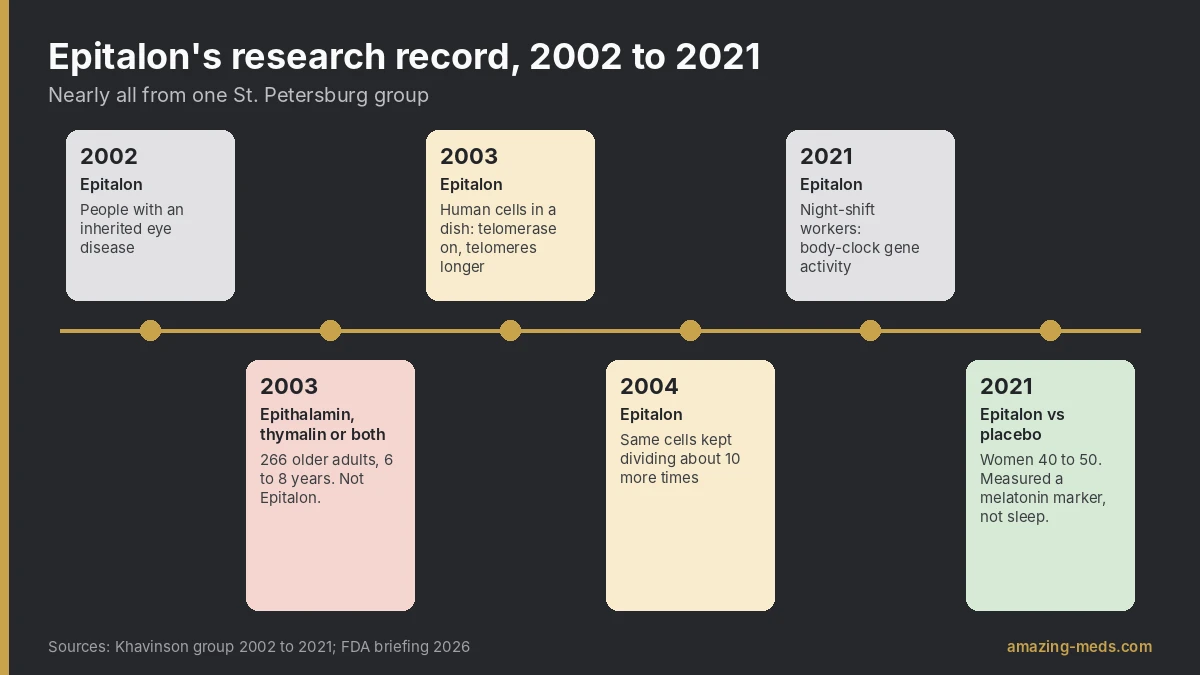
| Year | What was given | To whom | What it measured |
|---|---|---|---|
| 2002 | Epitalon, by injection near the eye | People with retinitis pigmentosa, an inherited eye disease | Eye function in one rare condition |
| 2003 | Epithalamin, thymalin (a thymus extract), or both | 266 older adults, followed 6 to 8 years | Survival and health outcomes. Not Epitalon. |
| 2003 | Epitalon | Human fetal fibroblasts in a dish | Telomerase and telomere length |
| 2004 | Epitalon | The same cell line, followed longer | How many times cells kept dividing |
| 2021 | Epitalon under the tongue | Night-shift workers | Activity of body-clock genes |
| 2021 | Epitalon or placebo under the tongue | Women aged 40 to 50, mostly night-shift workers | A melatonin breakdown product and clock genes, not sleep |
Sources: Khavinson et al., 2003; Khavinson et al., 2004; Khavinson and Morozov, 2003; FDA briefing.
The 2021 trial in women 40 to 50
This is the only placebo-controlled human study the FDA found, and it enrolled exactly the age group most likely to be searching for help with sleep. Of 75 women screened, the 40 with low levels of a melatonin marker were split into an Epitalon group and a placebo group. The study gave them an under-the-tongue spray for 20 days and tracked the melatonin marker and clock-gene activity. It didn’t measure how long or how well anyone slept.
The FDA reviewed Epitalon only for insomnia, and it found no study that tested insomnia at all (FDA briefing).
Sleep help with stronger evidence
If midlife sleep is what brought you here, two options have far more behind them. The American College of Physicians recommends cognitive behavioral therapy for insomnia, or CBT-I, as the first treatment for adults with chronic insomnia (Qaseem et al., 2016). And if night sweats keep waking you, The Menopause Society notes that hormone therapy improves sleep for women in that situation by cutting down on nighttime awakenings (NAMS, 2022).
What changed in 2026
The FDA’s advisory committee voted 7 to 4, with one abstention, to recommend Epitalon for the compounding list, for insomnia (American Med Spa Association). HHS followed in late October with a draft stating that the agency has no plans to bring enforcement against licensed 503A pharmacies that prepare Epitalon alone as a shot under the skin or into a muscle, as long as they follow its conditions. It isn’t FDA approval. The under-the-tongue spray from the 2021 studies isn’t a covered route. The HHS peptide policy lists each condition.
Epitalon and Amazing Meds
Ask your provider about current availability and whether an option fits your history. Given the cancer question FDA raised, tell your provider about any personal or family history of cancer. If sleep is the real goal, your provider can also check whether night sweats or other hormone shifts are behind it, talk through hormone therapy, and point you toward CBT-I. There’s no charge for the first consultation, and you can see what the process looks like ahead of time.
Epitalon FAQ
What do people take Epitalon for?
Sellers market it for longevity, telomeres and sleep. None of those uses is FDA approved, and the FDA found no study testing it for insomnia, the one use it reviewed.
Has Epitalon been shown to lengthen telomeres in people?
No human study has shown that. Telomere lengthening was reported in human cells grown in a dish, by one research group.
Why did the FDA raise a cancer concern?
Switching on telomerase and keeping cells dividing is also how many cancers grow. The animal cancer studies were short and limited, and there are no clinical safety studies.
Which forms of Epitalon does the HHS draft cover?
Injections under the skin or into muscle, with Epitalon as the only active ingredient, from a licensed 503A pharmacy that meets the draft’s conditions. The under-the-tongue sprays from the 2021 studies aren’t covered, and Epitalon remains unapproved and off the 503A bulks list.
Epitalon or epithalamin: what’s the difference?
Epithalamin is an extract from cattle pineal glands. Epitalon is a four-amino-acid synthetic peptide based on it. The FDA treats them as different substances.
For education only, not medical advice. Epitalon is not FDA approved, and the policy that covers compounded peptides could change. Speak with a licensed provider about your own health before trying any peptide.